
Beyond the Bench:
How Movement, Tech, and Club Culture Rewired My Sense of Performance

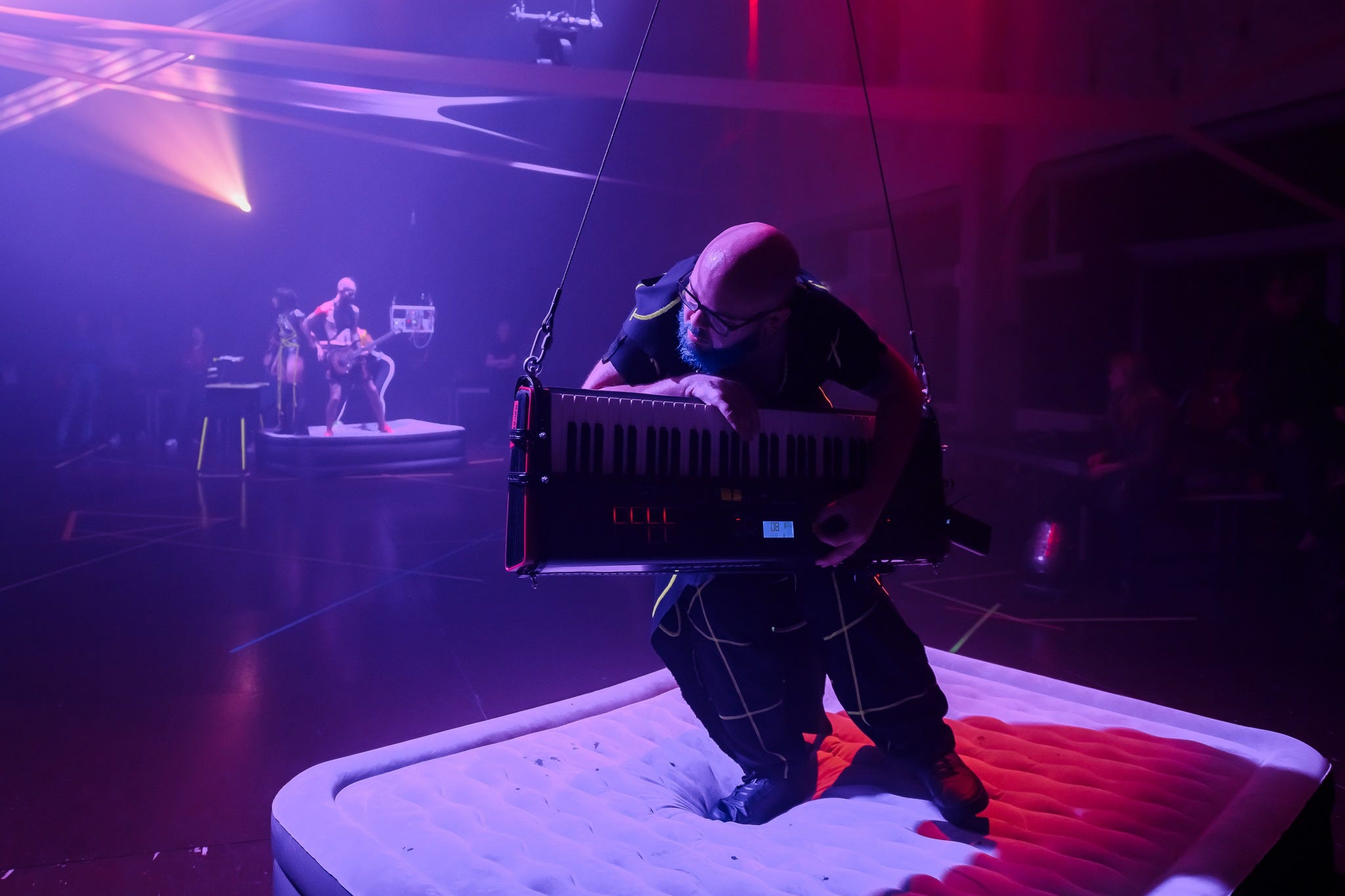
I’m writing this out of a need to figure some things out. Since 2021, I’ve been part of two productions that pushed me far from the piano bench. The first was growing sideways, a piece we’ve done several times since it first came together. The second was when we play, created in late 2024. Both were with the collective andother stage. Both changed how I understand performance. I’m classically trained. For most of my life, performance meant sitting still at a piano, playing something built in extreme detail and with a very narrow margin for flexibility (at least on the surface). Then I found myself dancing, improvising, wheeling a MIDI keyboard around, pretending I knew how to play electric guitar. I’m still trying to figure out what all of that means.
In one scene from when we play, I had to jump on an air mattress to reach a keyboard we’d hung from the ceiling. No stage. Just a big room with a few platforms (and the aforementioned mattresses). The audience stood among us. They were expected to move too—dance, wander, respond. The music drew from club culture: techno, drum and bass, some hyperpop. I’m used to performing in a fixed spot. Here, everything was in motion. The whole thing felt more like a living installation than a concert.
The first time I had to move like this was in growing sideways. The music for that was fully written out, but it also involved movement. Dancing felt like the right word, even then, though I didn’t feel comfortable calling it that at the time. There were no choreographed steps. We got behavioral instructions instead: move like a flock of birds, listen with your body, stay aware of everyone else. I felt ridiculous at first. My limbs, heck, my body, didn’t know what to do. But the longer we worked on it, the more natural it felt.
when we play took those ideas and amped everything up. The opening number—which shares the piece’s title—was a rave. The audience hadn’t even come in yet, and we were already running, jumping, dancing across the room. The music Jorge Sánchez-Chiong had written was a club track. But layered on top of it was chaos: fragments of material we had prepared, cues to improvise, bodies constantly moving. Once the audience arrived, we just kept going. We danced with them, improvised around them, and fed off their energy. That first scene was supposed to last 15 minutes - it ended up lasting about 25 instead. It felt like 5 and like 50 at the same time. And that was before I had to make a battery-powered keyboard work while dangling from the ceiling.
Getting ready for this show had almost nothing to do with practicing music. Making this work meant solving practical problems I’d never faced. I had to figure out how to power and mount a MIDI keyboard above my head. I used a 61 key MIDI controller hooked up to my laptop using a Panda Audio MIDI Beam system. Power came from a battery pack. Software-wise, I ran everything through Steinberg’s VST Live 2. The setup was supposed to be very simple but took weeks of tweaking. The MIDI would always stop working right before rehearsal started.
Physically, I had to train too. I definitely wasn’t in the kind of shape necessary for such a show when we started working on it. Brigitte Wilfing—who created both pieces along with Jorge—was a key part of making this possible. She never made me feel like my body didn’t belong there. She actually helped me figure out what it could do. She helped me use it in ways I’d never considered. As for the music, improvising was the easy part. Playing electric guitar was a bit less comfortable because…well, because I don’t actually play guitar. But that wasn’t the point.
One of the pieces I performed was a duo with Samuel Toro-Perez (who does know how to play guitar—particularly well!). It’s called Take the Lovebirds. We stood on the same platform, each holding an electric guitar. This one was a crazy post-something take on serialism that was almost exclusively about rhythm and timing. We’d start with different gestures, shift together to a new idea, then go back to separate ones. There was a moment in the middle where we locked into unison—shortly—then split up again. The material was choreographic and musical at the same time. What mattered was how tightly we could coordinate.
Later in the show, Samuel and I did another duo, but this time I was on a drawbar organ. We were tied to the columns of the building—and to each other—using latex bands. Every move we made found some resistance somewhere. Playing meant pulling, shifting, twisting. Sometimes we couldn’t reach the next chord unless we moved in sync. The piece became a negotiation between physical limitation and musical intention.
These productions didn’t make me stop playing classical music. But they did change how I think about it. I used to think classical training was the main thing. Now it feels more like a way in. It’s been about a year since we did when we play. I’ve gone back to more traditional concerts since then. But something’s changed. I get a bit restless at the piano sometimes. Not bored. Just aware that my body can do more than sit still. And now when I’m writing music, I think about movement earlier in the process. About what a performer’s body might want to do, not just what their hands can reach. The distance between me and the audience feels different now. The stillness feels like a choice rather than the default. I still sit at the piano. I still prepare carefully. But something about the approach has changed. These projects reminded me that music isn’t just about sound. It’s also about showing up, connecting with people, taking risks, and being willing to look like you have no idea what you’re doing. And that’s a wonderful feeling to have.
Both pieces were created by Brigitte Wilfing and Jorge Sánchez-Chiong. The collective andother stage includes them, me, Samuel Toro-Perez, David Panzl, Mirjam Klebel, Isabella Forciniti, and Otto Krause (among several other fantastic artists).
Una lectura muy interesante, gracias Alfredo. Yo también estoy pensando mucho últimamente en qué significa ser una violinista para mí, y siento que es una identidad que se está transformando.